20 August 2010

Newspaper Editorials for 20 August, 2010

The Australian:

One thing is abundantly clear, however: Kevin Rudd's big-government experiment was a disaster. Whichever party is returned, this ugly revival of old-style central planning must be buried and cremated. The Australian regrets taking Mr Rudd at his word in 2007 when he presented as an economic conservative who believed governments step in only when markets fail. The trouble was markets were deemed to have failed when Mr Rudd decided they had failed, and that was often. Long before the global financial crisis, the dead hand of government was touching the private sector in inappropriate places, and its behaviour grew steadily worse. GroceryWatch and FuelWatch were early signs of the hubris that resulted in the atrocity of a mining tax.

Our doubts towards Labor are about the party, not Ms Gillard, who has an abundance of courage and a talented frontbench team. Yet the financial crisis has revived a command economy culture we thought had been purged by Mr Hawke a quarter of a century ago. It was not big government that saved Australia from recession but the courage of leaders like Mr Hawke, Mr Howard and Paul Keating, who spent their own political capital on economic reform. The true test of a prime minister is not how he or she survives an external shock but how well they prepare us for the next one. It comes down to a question of trust in a contest between a leader who learned his trade under Mr Howard and one who served under Mr Rudd. On those grounds, we endorse Mr Abbott as our 28th prime minister.

The Australian Financial Review:

…By instinct, the Coalition would be less likely to waste taxpayers' money on risky projects than Labor, less inclined to sacrifice efficiency for "fairness" and protect weak industries, and more likely to embrace productivity-boosting reforms in welfare, tax and — hopefully by the 201 3 election — the workplace. Such reforms require real leadership. They are less likely to happen under Labor, which allows focus groups and unions to decide national policy and who should be prime minister.

We prefer the Coalition — which steered the economy through the 1997 Asian crisis and the fallout of the 2001 US recession. We hope, if elected, it learns better in office than Labor.

The Courier-Mail

This campaign has lacked detail on how to deal with those complex political and economic challenges, reducing the choice to a decision about what sort of country we want – one dominated by big government, or one where government gets out of the way to allow enterprise to thrive.

…The reason the Rudd/Gillard Government lost its way is that it believed fervently in the former and, in the process, squandered the trust and goodwill it received from Queensland voters in 2007, when it promised to confront contemporary issues more aggressively than the Howard government.

The past three years have been a story of government being presented as the solution to the nation's challenges, when in fact it only added to them…

This, in fact, is a strength and shows a commitment to the people he aspires to serve. We know well what Mr Abbott stands for because his positions are well chronicled. Like this newspaper, he stands for the strength of free enterprise empowered by less regulation and lower taxes. So does his party. The nation will be better for their return to government.

22 July 2010

Tony Abbott is more honest than Julia Gillard, says former Labor leader

In an interview on Sky News Australia, former leader of the federal ALP gave this blunt assessment of the honesty of the leaders of the two major parties:

Mark Latham: So every single slip, every wrong word, almost every misplaced syllable by a party leader it’s seized on. I’ve seen that already in this campaign. It’s seized on, as a story way out of proportion with its public interest value. So that encourages the politicians to narrow down, give them absolutely nothing and what we’ve seen so far in this campaign is that Gillard is really a changed person. She used to be fairly sort of free-wheeling and open about things. She has mastered the art of narrowness in public life whereas Abbott who, you know, really can’t sort of restrain himself from being a little bit honest is more likely to lead himself into an answer that, you know, is more honest than what Gillard’s giving people.

David Speers: But you’re saying Tony Abbott’s more honest in this campaign than Julia Gillard?

Mark Latham: Well he’s more inclined to speak his mind which you know should be a virtue, in a normal system it would be a virtue but in a system we’ve got now where the narrowness is absurd, there’s absolutely nothing in it for a politician to have an opinion that is outside the narrowly scripted message of the day on the campaign trail and this will be an ongoing problem for Abbott. Abbott who, for whatever reason, can’t sort of control himself in that regard is obviously going to find some …

5 July 2010

Julia Gillard continues to mislead voters on the Australian Constitution

Julia Gillard wants voters to forget that Australia is a federation of states with rights that are enshrined in the Australian Constitution, because they don’t sit well with Labor’s agenda to further centralise power in Canberra.

One of the central themes of the Rudd-Gillard Labor government’s campaign to win votes for its proposed Minerals Resource Rent Tax (MRRT) is that the nation’s minerals are owned by all Australians. As the government realises, this statement is misleading, as talkback radio host Alan Jones pointed out in his interview with the Prime Minister on 2GB last week:

JONES: -All company tax is profit-based, Julia. All company tax is profit based.

PM: Yes, but Alan, Alan, let’s just, absolutely right, I’m agreeing with you, we’re not having an argument about that. What’s different about mining? The key resource us a resource that is owned by everyone and we’ve got to work out what that’s worth. Historically-

JONES: -That’s not quite right, either. Constitutionally, what’s under the ground is owned by the States.

PM: Well, you know, Australians, Alan - whether they’re sitting in their States or sitting in their nation, it’s owned by Australians.

Australia’s minerals are owned by the Crown in the right of the states (excepting the territories), not in the right of the Commonwealth as the government is suggesting with its spin. It is clear from Section 114 in Chapter V of the Australian Constitution that while our minerals are owned by Australians, not all Australians own all our minerals:

114. A State shall not, without the consent of the Parliament of the Commonwealth, raise or maintain any naval or military force, or impose any tax on property of any kind belonging to the Commonwealth, nor shall the Commonwealth impose any tax on property of any kind belonging to a State.

18 June 2010

Coming to your PC: the Rudd Desktop Assistant

Remember Clippit, the animated paper clip that would appear and offer assistance when you started using a Microsoft Office application for the first time? It might have impressed some people with its animated stunts, but when it came to delivering the help you needed, all too often it responded with irrelevant answers to your questions. It looked very friendly, but when you wanted to get down to doing serious work it became an annoying, unwelcome intrusion. Now just imagine what it would be like to have a Kevin Rudd variant of this feature running in the background on your PC all the time, because this is in essence what might pop up after downloading and installing the application that the Rudd Labor government just announced would be available for parents seeking protection for their children online.

When Senator Conroy's desktop panic button was launched last week, it was derided by the online community as a waste of taxpayers' money because it was nothing more than a help button which connects the child to resources online—or so they thought. It would be naive to think that this button—reported to cost $73,000 to develop and includes the ability to update itself automatically—will do nothing more in future.

Perhaps the Rudd Labor government intends to quietly dump its unpopular plan for mandatory ISP-level filtering by sneaking in an update for PC-based filtering. However, this is a custom-built application and development is ongoing—not an existing commercial product available off the shelf—so we can only guess what the government plans to do next with its panic button.

The intentions of the Rudd Labor government's ideas for the Internet need close scrutiny, because a picture is emerging of a government obsessed with centralised monitoring and regulation of activity on the Internet. If the government is planning to make ISPs retain the browsing history of Internet users as some people in the industry claim, then it is more out of touch than it seemed at first with its plans for mandatory ISP-level filtering. Internet users can conceal their browsing history via the same methods as those used to circumvent ISP-level filters, such browsing via a Web proxy. It is obvious that they are not listening to expert advice in the development of their policies.

16 June 2010

Sand and gravel included in the Rudd government's mining tax grab

Despite being included in a list of resources that may merit exemption in the Henry Tax Review, lime, phosphates, sand and gravel will be subject to the Rudd Labor government’s proposed Resources Super Profits Tax (RSPT). Senator Wong couldn’t explain why the government chose to include these resources in the proposed tax on mining in yesterday's session of Question Time in the Senate.

Senator WILLIAMS (New South Wales) (2:28 PM) —My question is to the Minister representing the Minister for Resources and Energy, Senator Wong. I refer to the detailed analysis of the Henry tax review, table C1-1, headed ‘Resources that may merit exemption from the resource rent tax’. It lists more than 33 resources that may merit exemption. Why will these resources—including lime, phosphates, sand and gravel—still be subject to this massive new tax grab?

Senator WONG (South Australia) (Minister for Climate Change, Energy Efficiency and Water) —As I made clear in a previous answer, obviously the Henry tax review falls within the Treasurer’s portfolio, so if you have questions on the detail of that, Senator, I would suggest you put them to Senator Sherry, who represents the Treasurer. I can assist in relation to a number of the issues raised, however. For example, I would make the point that the move to a profits based regime will obviously, in general, be of greater assistance than a volumes based regime for more marginal operations. I make that as a general proposition.

The second point I would make is that a number of the commodities that you have discussed—not all, but some—are traded on world markets and obviously have their price set by world markets. For example, you mentioned phosphate. ABARE has advised that the price of phosphate is determined on world markets and by movements in the Australian exchange rates. I also make the point that, as I responded in response to an earlier question, the government’s modelling has indicated that the introduction of this reform, the replacement of royalties and the reduction in the company tax rate for all companies has, in fact, been independently modelled to bring down consumer prices by 1.1 per cent as well as to ensure that there is an increase in output as I have previously described. It may suit those opposite to run scare campaigns around a whole range of issues here; the fact is that this is about economic reform. It is about building a stronger economy and recognising that the benefits of the resources sector should be more fairly shared amongst all in Australia and should be utilised to make investments in other parts of our economy such as regional infrastructure, superannuation and reduction in the company tax rate. (Time expired)

Senator WILLIAMS (New South Wales) —Mr President, I ask a supplementary question. Given that the small quarries will face an effective tax rate of 57 per cent despite the Henry review advice, what modelling has the government done in relation to the effect of the obvious price increases in these infrastructure and fertiliser products?

Senator WONG (South Australia) (Minister for Climate Change, Energy Efficiency and Water) —Again, I do not know where you are quoting your figure from. I again remind you that this is a profits based regime which obviously only applies after a certain threshold which incorporates a rate of return. In relation to some of the fertiliser and fertiliser ingredients that you reference, I have indicated to you that a number of these commodities are in fact traded commodities and would have their prices set on world markets. The low-value commodities that are used as agricultural inputs are usually lower profit—

Honourable senators interjecting—

Senator Brandis —Mr President, a point of order: the question was limited to whether or not modelling had been done with relation to the effect on these commodities. Nothing that the minister has said has gone anywhere near the question of whether or not modelling was done. You should bring her directly to the question.

The PRESIDENT —I am listening to the answer that the minister is giving. It is a little bit difficult with the interjections that are taking place across the chamber. If they were not happening, it would be much easier to hear the comments that are being made.

Senator WONG —The modelling is the Econtech modelling which I have previously referred to. I was attempting to be of some assistance to the senator and to give him a specific answer in relation to the agricultural inputs he raised. The advice I have is that these are usually lower profit and, therefore, unlikely to face a higher tax burden under the RSPT, particularly given the replacement of royalties with an RSPT. I also indicate that the government is clearly consulting on this implementation. (Time expired)

Senator WILLIAMS (New South Wales) —Mr President, I ask a further supplementary question. Will the government pay financial compensation to state and local governments that will face obvious increased costs in road construction and community infrastructure because of this big new tax on all quarries that supply these resources?

Senator WONG (South Australia) (Minister for Climate Change, Energy Efficiency and Water) —What the government is doing, as the Prime Minister has announced, is implementing a $6 billion regional infrastructure fund. This demonstrates why tax reform is so critical to Australia. A fund means that we can begin to tackle our urgent infrastructure needs now and put something back into the mining communities that make our economy strong. The reality is that this is a tax that is about investment in infrastructure, investment in superannuation, investment in a reduction in the company tax rate for the other sectors of the economy, a fairer share and a stronger economy.

11 May 2010

Media release from Shadow Treasurer Joe Hockey: A Shameless Con

This Budget confirms that Kevin Rudd and Wayne Swan are addicted to spending and allergic to tough decisions.

This is another big taxing, big spending Labor Budget with no serious reform.

The Budget assumes less smoking with higher tobacco taxes, yet it assumes more investment with massively higher mining taxes.

Kevin Rudd and Wayne Swan are asking the Australian people to trust them to deliver a Budget outcome that is based on the most favourable terms of trade in 60 years, assumes a significant increase in investment in resources and assumes no new additional Government expenditure between now and 2014.

The Budget’s return to surplus relies upon a great big new tax on Australia’s resources sector, not tough decisions.

This great big new mining tax is a dagger to the heart of the Australian economy, putting major projects at risk and sending jobs offshore.

Mr Rudd and Mr Swan want to sacrifice Australia’s future economic prosperity to improve the numbers in this Budget’s bottom line.

Spending in this Budget will increase by $26 billion over the next three years relative to last year’s record spending forecast.

The Government will have to borrow over $700 million a week to fund its reckless and wasteful spending — putting upward pressure on interest rates and the cost of living for Australian families.

Interest on net government debt will be $4.6 billion in 2010/11.

By 2012/13 the Government will be spending $6.5 billion a year on interest payments.

The peak debt bill of $93.7 billion will be the amount owed by the Australian people to pay for Kevin Rudd’s spending spree.

The Government has not taken a single tough decision to rein in its reckless and wasteful spending. The improvement in the Budget’s fiscal position is a direct result of a growing economy and stronger terms of trade combined with tax hikes on miners and cigarettes and an attack on private health insurance.

The Budget also exposes the costs of the Government’s waste, mismanagement and policy failures, including a $1 billion blowout as a result of Kevin Rudd weakening Australia’s borders and $1 billion being spent to fix Labor’s tragic home insulation mess.

TAX:

The Government’s $9 billion a year mining tax will damage the sector of the Australian economy which did the most to see us through the Global Financial Crisis. Already this reckless decision has resulted in BHP casting doubt over the $20 billion expansion of Olympic Dam, Santos deferring a decision on a $15 billion LNG export-terminal in Gladstone, Xstrata suspending a $30 million regional exploration programme, and Origin Energy predicting increases in domestic energy and fuel prices.

Small business across Australia will be deeply concerned by the additional $445 million that Mr Rudd and Mr Swan will be giving to the Australian Taxation Office for increased compliance.

BILLION DOLLAR BOAT BLOWOUT:

Labor’s Budget reveals the economic cost of Kevin Rudd losing control of Australia’s borders.

Offshore asylum seeker management has blown-out by a massive $777 million since last year’s Budget. This blow-out in offshore management costs has occurred at the same time as Kevin Rudd has walked away from his commitment to universal offshore processing. Labor will spend an additional $202 million on accommodation for illegal arrivals both on Christmas Island and on the Australian mainland in Darwin, Sydney and Port Augusta.

HOME INSULATION PROGRAMME:

The Budget confirms that Kevin Rudd’s home insulation disaster will cost at least $1 billion to fix, with thousands of homes across Australia still not inspected in the aftermath of the scheme’s cancellation. The Home Insulation programme which has been linked to four deaths and resulted in 240,000 dangerous and dodgy insulation jobs, 1,000 electrified roofs, and 120 house fires, will now cost the Budget a further $1 billion. This programme is the most monumental failure of government policy in living memory.

LABOR SPIN ON SKILLS, EDUCATION AND EMPLOYMENT:

By setting a target for full employment at an unemployment rate of 4.75 per cent in 2012, the Government is effectively giving up on the employment prospects of 75,000 Australians.

The Government’s promise of a $661 million for skills investment re-badges $601 million of existing spending, including a $456 million cut in the Productivity Places Programme.

Further delays in the Julia Gillard school halls programme will mean that $500 million of stimulus funding will not be spent until 2011/12, at least three years after the Global Financial Crisis.

HEALTH:

The Budget confirms that Kevin Rudd’s health policies will be about more bureaucrats and not better services. The Government will spend around $500 million to establish new layers of Commonwealth bureaucracy. In less than a month, Kevin Rudd has broken his promise of no net increase in health bureaucrats.

Having broken his election promise and built just two of 36 GP super clinics, Kevin Rudd is now asking the Australian people to trust him to build 23 more. On this conversion rate, Australians can expect this latest promise from Kevin Rudd to deliver just 1.4 extra super clinics.

Furthermore, what the Government isn’t telling people is that only 9 of the additional 23 super clinics will be at full scale.

ENVIRONMENT:

Having shelved its response to what Kevin Rudd described as “the greatest moral challenge of our time”, the Budget demonstrates that the Government does not have a credible policy on climate change. The Coalition remains the only major party with a policy that will reduce carbon emissions by five per cent by 2020 while at the same time delivering good environmental outcomes.

But the Budget confirms that Kevin Rudd’s original great big new tax on everything — the ETS — will be coming back after the election.

MORE WASTE AND GOVERNMENT ADVERTISING:

In an undisguised election campaign strategy, the Government will spend $126 million on print, radio and television advertising.

Despite having no climate change policy, the Government will spend $30 million for another climate change advertising campaign.

The Government will also spend $38.5 million over two years to advertise the outcomes of the Henry Tax Review even though they only adopted a handful of the Review’s 138 recommendations.

Despite having not even introduced their Paid Parental Leave (PPL) legislation into the Parliament, for the second Budget year running, the Government has committed funding for PPL advertising to a new total of $12 million.

The Prime Minister’s daily PR spin on hospitals will continue with a new $29.5 million advertising campaign to sell their health package even though Western Australia has not signed on and all new beds won’t even be delivered until 2013-14.

With broadband services under the NBN still years away, the Rudd Government has committed $16 million over two years, including $7.6 million in the current financial year, on an NBN advertising campaign while at the same time, cutting $16.4 million from the previous Coalition Government’s ‘Australian Broadband Guarantee’ programme which ensured fast and affordable broadband.

It would appear that politically motivated government advertising is more important to Kevin Rudd than the $21.2 million programme to combat illicit drugs, from which he has cut $4 million.

DEFENCE

Wayne Swan’s Budget delivers Kevin Rudd’s priorities to Defence — more bureaucrats and less to the front line, increasing civilian numbers by 1,500 and cutting the number of uniform personnel by 500. The Budget will also place greater pressure on recruitment and retention in the ADF with further cuts to the successful defence gap year programme.

INFRASTRUCTURE:

The Budget does not invest a single additional dollar in Australia’s major road networks. There is no additional funding for the duplication of the Pacific Highway, making a farce of Kevin Rudd’s commitment to finish the duplication by 2016 — another broken promise.

11 May 2010

9 May 2010

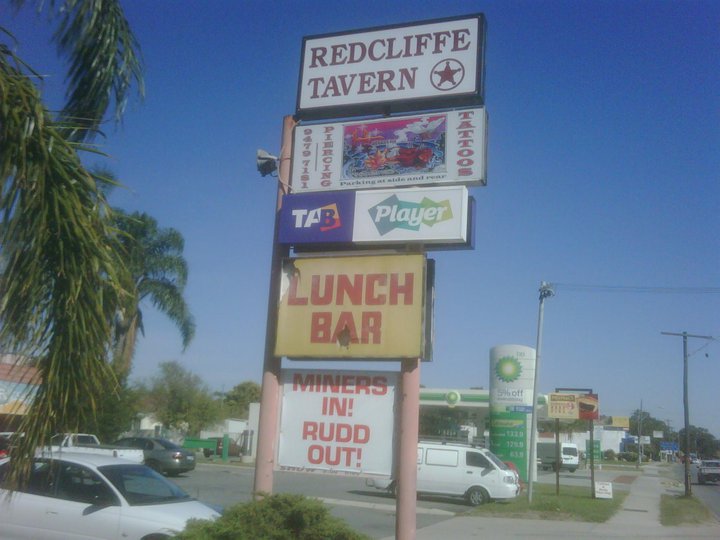
The sign says it all

Photo taken in Redcliffe, Perth.

Miners in! Rudd out!

7 May 2010

There was no "fat finger" 16 billion trade that led to Wall Street's largest intraday plunge

The story that Wall Street's biggest intraday plunge in history was caused by a trader accidentally entering 16 billion rather than 16 million for the quantity of a sell order is nonsense. A check of the New York Stock Exchange's technical specifications reveals that the maximum quantity for trade orders is 6.5 million shares.

16 April 2010

Issues of ISP-level filtering

Simple illustration of the flaws with ISP-level filtering. Call me old-fashioned, but I believe it’s better to tackle the problem at the source. Internet users aren't the only victims of child pornography.

Issues of ISP-level filtering

14 April 2010

Conroy spun the filter trial, and out came a report fluffier than a Himalayan cat that's been through a clothes drier

Senator Conroy has had more than enough time to provide clarity, substance and certainty on his planned mandatory Internet censorship regime. With each day that passes that their calls for reason, common sense and clarity on this issue are ignored, Australians with legitimate concerns about this policy grow ever more cynical about the ability of their politicians to understand and represent their views on issues relevant to ordinary Australians. In this age many Australians consider the Internet to be fundamental to their every day personal communications, just like the analogue telephone which is being replaced by VOIP, where voice telephony is delivered via the Internet. Many Australians consider this a serious issue that warrants robust and informed debate involving all stakeholders, and for it to be based on fact.

The Enex TestLab report is misleading and has Senator Conroy’s fingerprints all over it. Take for example the feedback from customers on page 28:

Over-blocking
Participants were asked if access was blocked to sites that they thought they should have access to (e.g. to identify perceptions of over-blocking). Only a couple of respondents indicated that they were frequently blocked access to sites they should have had access to, while most respondents reported that they were blocked “possibly once or twice”. A number of users reported they were “unsure” as to whether they had been blocked unnecessarily and some customers commented on the benefit of seeing some “output” of the filters action.

Proponents of the government’s policy might think that this is just collateral damage in the war on child pornography because it appears in the section of the report titled Customer Feedback — Additional Content Filtering, which covers the impact of the optional “family” filter on customers’ experience. We don’t know whether reports of over-blocking and other negative feedback can be attributed to the mandatory filter which was used at the same time for customers who participated in the trial of the filter for optional additional categories. They did not seek feedback from customers who participated in the trial of the mandatory filter alone.

Conroy boasts that the AMCA filter is 100% accurate. It’s just like throwing a net into the ocean, pulling out a few fish and saying “See these fish I’ve caught? It’s 100% accurate at catching these fish.”

You don’t have to embrace libertarianism to see the insanity. The end does not justify the means, especially when evidence that the end will be achieved does not exist. Will it block 5% of child pornography on the Internet? Will it even block 1%? Nobody knows. It’s hard for experts to provide clear answers when they are not provided with clearly defined aims. Also, it’s hard to disprove something that was never proven in the first place. The government has failed to demonstrate that the technology it intends to impose on each and every Australian will be effective in protecting children from child pornography.