18 October 2009

They can "get away with higher prices" - IGA distributor

WA IGA President John Cummings claims that locally owned supermarkets are "highly competitive" according to a survey he "personally conducted", where a basket of products sold at his IGA store in Glengarry were compared with products purchased from Coles and Woolworths stores in the Sydney suburb of Warringah. In his findings, Cummings stated:

The only conclusions to be drawn from this survey is that Perth shoppers are either well served by the independent sector and that the independents continue to put downward pressure on day-to-day grocery prices, or both Coles and Woolworths are engaging in blatant price gouging of consumers in Sydney.

Cummings' personal research is not as definitive as he would like to believe, especially when one looks at one of the slides from a presentation that was given by Reitzer, CEO of Metcash, to US investors:

Reitzer tells investors that one of the reasons that Metcash's "independent" grocers have been successful is that "their location or format allows them to get away with higher prices." Far from having the downward pressure claimed by Cummings, Reitzer boasted that IGA is able to defy market forces and rip off consumers.

17 October 2009

The 800-pound gorilla standing in the way of extended trading hours

We keep hearing the same arguments against deregulation of retail trading hours in Western Australia: small shops will be put out of business by Coles and Woolworths and the results of the referendum held in 2005 on this issue show that the public do not want reform. Unfortunately, we would be naive to assume that the opponents of deregulation who give these flawed arguments have the general community's interests at heart and not their own.

The ACT and Northern Territory both have completely unregulated trading hours. Tasmania's trading hours are unregulated on all but two and half days of the year. Notwithstanding the claims made by the independent grocers' lobby, liberalisation of trading hours in other states and territories has not had an adverse impact on the performance of independent grocers.

The people were not asked in the 2005 referendum whether they wanted extended trading hours, but whether they thought it was good public policy. Furthermore, IGA led a fear campaign in the lead up to the referendum with claims such as extending trading hours threatens 15,000 jobs, which is totally absurd.

All the economic debate that has surrounded this policy issue is just a distraction from the grubby rent seeking and politics that are driving the resistance to reform. Metcash, the distributor for IGA and Foodworks that benefits from the current regulatory regime, donated a total of $26,000 to the WA Nationals for the financial year of 2007/2008, as reported on the Australian Electoral Commission's website.

Donations to WA Nationals for 2007/2008 reported by donors

The disclosed donations for the financial year of 2008/2009 are yet to be published, but they will be interesting indeed. The Barnett Liberal government introduced legislation to extend retail trading hours, but this was blocked by the Nationals and Labor opposition. The Liberal government then explored an alternative approach to extending trading hours without passing legislation through the Western Australian Parliament: extending the boundaries of the Perth tourism precinct, which the Nationals said they would block via a disallowance motion—they even blocked changes that didn't affect the constituents of any of the seats they hold.

10 September 2009

Finance Minister takes swipe at Hockey over Twitter use

Lindsay Tanner, Minister for Finance and Deregulation, took a swipe at his counterpart in the opposition yesterday over his use of Twitter within the chamber:

Mr TANNER —I am delighted that the member for North Sydney has dragged himself away from his twittering for a few moments. We know he has got an attention span problem, but it would be good if he actually paid attention to the parliament rather than sitting there twittering all day.

It is clear from a quick glance at his Twitter profile that he has his Twitter use very much under control. Given that the majority of the government's responses to questions are irrelevant and leave us none the wiser on how it intends to deliver on its policy commitments, it is fair to say that he is not necessarily making less productive use of his time communicating with his supporters and the wider public via social networking sites.

23 August 2009

Joe Francis to Eric Ripper on retail liberalisation: bring it on

Joe Francis MLA, Member for JandakotTranscript of the speech delivered by Joe Francis MLA, Liberal member for Jandakot, to the Western Australian Legislative Assembly on 18 August 2009.

MR J.M. FRANCIS (Jandakot) [4.14 pm]: I understand that this is a fairly passionate issue for many sectors of the community. Sometimes there is no black and white answer to some of the questions that are posed. I honestly appreciate the input that members opposite have made to this debate. However, I do not come here and lightly make a decision that will hopefully in some way affect the lives of my constituents, without giving it very serious consideration and certainly without talking to them first. We will obviously agree to disagree on many matters.

I did go through some of the history of this matter, and I will touch on it briefly. When the retail trading hours laws were first introduced into Western Australia 20-odd years ago, there were three main reasons for it. They confirmed the regulations that were already in existence; they were intended to give a limited protection for the lifestyle at the time; and they also preserved the idea, to some extent, that Sundays were family days and that retail workers, where possible, could ensure they would have a shorter working week.

Mr W.J. Johnston interjected.

Mr J.M. FRANCIS: I am talking about the original act that enshrined rules that were already in place. It has also been 21 years since Australia celebrated its bicentenary.

Mr W.J. Johnston interjected.

Mr J.M. FRANCIS: The member will get his chance to make a contribution. Australia in 2009 is a very different place from what it was 21 years ago, and that includes Western Australia. Our lifestyle, population, work ethic, standard of living, spending habits, working hours and society have changed dramatically in that time. Metropolitan Perth is really no exception. Changing lifestyles mean that more people have been undertaking tertiary education, vocational training and shift work. More people are involved in fly in, fly out work, and there is more casual and part-time work. The whole gamut of employment and lifestyle issues has changed the shape of metropolitan Perth. As well as the demand for this kind of work there has also been a demand for flexibility in shopping hours. That is obviously mainly around the retail sector. Unfortunately, although so much has changed, the one sector that has not changed is the retail sector, apart from in 1994 when shopping hours were increased from 12 o'clock on Saturdays until later. I would hate to see the response if any member threatened to wind back the clock on that one. I remember going to shops when they shut at 12 o'clock, and it was not a pleasant experience.

One of the things that have surprised me in this debate is that the Labor Party members have said that they consulted with small businesses. Some have said that they consulted their constituents.

Point of Order

Mr C.J. BARNETT: There are some standards in Parliament, and one of them is that people do not drink out of bottles; indeed, members should not consume liquids in the house. Members should not consume liquids or food, and they should not drink out of a bottle in the house. If the member for West Swan wants a drink, she should use a glass, be civilised and be courteous.

Ms R. SAFFIOTI: When I talked to the Speaker about my pregnancy, I asked whether I could bring bottled water into the house because I do not drink water that has been left around for a while. He said that it was okay.

Several members interjected.

The ACTING SPEAKER: There is no point of order.

Debate Resumed

Mr J.M. FRANCIS: The point I wanted to make—I hate to talk about obvious observations—is that one of the issues that has not been raised is that the current retail trading regime in Perth —

Several members interjected.

The ACTING SPEAKER: Order! The member for Mandurah is on two strikes. I do not want to formally warn him for a third time. I have given the call to the member for Jandakot, and the member for Jandakot is the person whom I would like to listen to at this moment.

Mr J.M. FRANCIS: Thank you, Madam Acting Speaker. I am trying to do this in a non-confronting way. The issue that has not been raised is that the current regime really benefits the rich. Let me explain why to the member for Wanneroo, because I know he will be fascinated by this. The bill deals with trading until 9.00 pm on Monday to Friday, but if people live closer to a tourism precinct, and the main one is the city, they are probably more likely to own more expensive real estate. If they want to go shopping outside normal trading hours, they do not have far to travel. People who live at Jandakot or Armadale have a bit of a hike to get into the city. There are so many inconsistencies with retail trading laws that I would be absolutely surprised if members did not realise that the current regime benefits those people who live closer to the city and tourism precincts as opposed to those people who live in the suburbs in the south east and must make the extra effort to go somewhere to make a considered purchase.

Ms A.J.G. MacTiernan: Have you analysed how people voted in the referendum?

Mr J.M. FRANCIS: I have.

Ms A.J.G. MacTiernan: Had you done that, you would see that, contrary to your speculation, the further people are from Perth the less inclined they are to support it.

Mr J.M. FRANCIS: The member for Armadale makes a good point. I do not write off the referendum lightly, but I will make this point: if a referendum were held now, it would be very hard to say what the outcome would be in my electorate because in the referendum held in 2005 only 11 000 people were on the roll in Jandakot; since then, 10 000 people have moved into the area. I see what happens in my electorate. I see the absolute nightmare that people go through when shopping on a Thursday night and a Saturday. I am thoroughly disappointed with the member for Cockburn, because generally the majority of my constituents shop at the same shopping centre, Cockburn Gateway Shopping City, and it is not easy to move about there—shoppers cannot get a car park. Extending trading hours on Mondays to Fridays would alleviate the Thursday night and Saturday rush for the soccer mums and the mums and dads with other sporting commitments who force the issue of grocery shopping into their weekend regime. For working mums and dads—I hate that phrase—extending trading hours would give them the option to do their grocery shopping on a Monday night, a Tuesday night or a Friday night. Effectively, whatever we may say, we are really talking only about food and groceries. It is matter of choice for consumers and it is also a matter of choice for business owners—that is, whether they open.

That brings me to another issue—namely, the results of the referendum. I appreciate that a large percentage of people did not vote for extended hours at the recent referendum. However, it was a fairly loaded question. When talking about loaded questions, it is well worth noting the consultation done by members opposite in their electorates. I refer to the letter sent to small businesses by the member for Victoria Park in which he stated —

I am surveying all businesses in my electorate of Victoria Park to seek your views in relation to extended weeknight trading.

I have to say that other members opposite used the same loaded questions asked by the member for Victoria Park. These are pretty loaded questions. For example, the member for Victoria Park asked —

2. Do you support the State Government overturning the results of the 2005 referendum?

He should have asked whether people thought that business owners —

Several members interjected.

Mr J.M. FRANCIS: If members opposite want me to go through it, I will. They loaded the questions. If members opposite had sent out a survey that asked whether business owners thought that they should be able to determine when they can and cannot open their businesses, it might have been —

Mr P. Papalia: Which line do you reckon we will run at the election?

Mr J.M. FRANCIS: Be it a big business or a small business, shareholders—the member for Warnbro's constituents own shares in big businesses—are denied the opportunity at the moment.

Mr P.B. Watson: Not too many of mine do!

Mr J.M. FRANCIS: They do, in their super funds.

When it comes to the last referendum, regardless of what anybody says in the house, I would have to say that any person who seriously voted on this issue—I am asking for the member for Warnbro's indulgence and for him to put on his political strategist's hat—did not log onto the Liberal Party's website and read the policy document. People made up their minds reading the front page of The West Australian just before the election. Before the last election, people who really cared where the Liberal Party or the Labor Party, or any party, stood on the retail trading hours made up their minds after reading the front page of the paper and the quotes from the Premier. Robert Taylor wrote —

A Liberal Government would extend weekday shopping hours in its first term and fix some anomalies limiting weekend trading but would retain the ban on major grocery chains opening on Sundays, Opposition Leader Colin Barnett said yesterday.

A little later, the article continues —

He would seek to reach a consensus on extended Monday to Friday trading with the major grocery chains, Coles and Woolworths, industry and employee groups after he was elected.

The article goes on to quote the then Leader of the Opposition —

"On general trading hours I would sit down with Coles and Woolworths and the independents, consumer groups, representatives of the employees and industry," he said.

"The agreement I'd be seeking would be to extend weekday shopping as the next step in deregulation. Any staged deregulation needs to have time and I would want this to settle down before any further step in deregulation, so for the coming term of government if we can reach agreement what would be on the agenda would be an extension of weekday trading."

Mr Barnett insisted his move to extend weekday shopping hours honoured the spirit of the referendum, which rejected further deregulation.

He said —

"I respect the referendum result that was held. Labor failed to govern, they deserted the issue, they asked the people and now they're ignoring the people. I will not do that no matter what might be my views about deregulation,"

The point is, as I have said, people who voted on the issue of extended trading hours really did not make up their minds on the basis of what was on a website hosted by the Liberal Party or the Labor Party, but by reading what was in the mainstream media. It is pretty black and white. The heading on the front page of The West Australian states —

Libs promise late shopping on week nights

Mr P. Papalia: Did the Premier canvass it with the Nationals when he formed government?

Mr C.J. Barnett: No.

Mr J.M. FRANCIS: We were not a coalition going into the election. The National Party had —

Several members interjected.

Mr J.M. FRANCIS: I will tell members what the member for Warnbro's problem is with the debate about the National Party: the National's position, going into the election, was black and white.

Mr W.J. Johnston: Ours was black and white and yours was.

Mr J.M. FRANCIS: According to the Weekend Courier, the member for Rockingham —

...said he welcomed Labor's plan to extend trading hours, which would allow Sunday trading in Rockingham and continued trading on public holidays.

Mr P. Papalia: You are in government. You cannot get three of your own cabinet ministers to agree to your own legislation. You are a joke! The government is a joke.

Mr J.M. FRANCIS: Members opposite were far more divided on this issue than we ever were.

Several members interjected.

The ACTING SPEAKER: Order, members! I am sure Hansard has no hope whatsoever of recording any of this debate, which may in fact be in the wider interests of the general public. I call on the member for Jandakot to continue. Member for Warnbro, you are on two strikes.

Mr J.M. FRANCIS: Members opposite know as well as I do that the Labor Party has flipped and flopped on this issue for a long time. We know that in her heart the member for Armadale wants Sunday trading—I note her comments on 18 November of last year. The member for Willagee wants it, although he has changed his mind a number of times on this issue. There are a lot of facts and there are a lot of myths.

The retail sector in Western Australia is worth about $25 billion annually and we know that it employs about 74 000 people. Extending trading hours would give us the potential to grow that sector ever larger. In every state across this country that has slowly deregulated its trading hours, the figures and the facts prove that the retail sector has slowly grown greater than what could have been expected had that deregulation not happened.

As I have said, this is really a groceries issue. It comes down to the fact that at the moment some operators, through fairly convoluted and undisclosed franchise agreements, get away with not having the required minimum number of staff on their payroll. They are, therefore, exempt from the act and can open under certain provisions. My challenge to the people who run those stores and who essentially have a monopoly on extended trading hours, including late nights and Sundays, is that, if they really want to play fair and in the sprit of the game, they should publish their franchise agreements. Let us know what they say. Let us see that they are truly independent operators. Companies such as IGA are generally influenced by Metcash, a fairly large South African company, and I would hate for people to wrongly assume that they are not as independent as they make out to be. It comes down to a choice for consumers. At the moment, companies such as Aldi, a fairly large and popular discount retailer of grocery items in the eastern states, will not come to Western Australia. Aldi will not come to Western Australia because it does not think that the market is big enough for it to compete in. It is not the population size—in fact, there is an Aldi store where my parents live in Moss Vale in New South Wales. Certainly, towns such as Bowral and Moss Vale do not have anywhere near the population of my electorate alone. It is important to get a few other matters right as well. It is important to point out that this legislation does not force people to open; it just gives people the option to open.

I want to mention one of my experiences. In 2003 I was on a navy ship, HMAS Tobruk, when it berthed in Ho Chi Minh City in Vietnam. When we pulled in there, I thought, "Well, we are in a communist country; it is going to be fairly backwards here." However, what stuck out more than anything else was that retail shop owners in Ho Chi Minh City, in a communist country, were not told by their government when they could or could not open their shops. But we do it in Western Australia. It is absolutely ludicrous.

Anyone who believes in the spirit of competitive capitalism, as I do and hopefully everyone does, will realise that increased competition will only benefit the consumer. I can use the example of my little local independent store. To be honest, it rips me off every single time I walk in. I pay 15 bucks for a jar of coffee that I can buy for seven bucks elsewhere. The tomatoes are green, the cheese is mouldy, the milk is at use-by date, the ham is sweaty—yet I am forced to pay the price. I do not have the option to go, after hours, to Coles or Woolies because they are not open. If Coles and Woolies could open —

Mr P.B. Watson: You don't support your local business if you go to Coles and Woolies.

Mr J.M. FRANCIS: There are two little businesses. One is in my electorate and the other is in the member for Cockburn's electorate, which I will come to, and they are poles apart. The extra amount of time that it takes to drive to the other shop is so great that people only go there to buy the minimum number of consumables. If I had to choose whether to go to Coles or Woolies tonight rather than the local guy around the corner, I would go to Coles or Woolies. I would do that to send my so-called local independent retailer a very clear message; that is, stop ripping me off or I will go somewhere else. These little guys can compete with the big businesses.

There is a little retailer in the member for Cockburn's electorate called Tony Ale and Co. I would encourage anyone to go there when they are in that part of South Lake. Tony Ale walks into Canning Vale markets, the fresh food markets, not the flea markets, at 4.00 am every day when they first open. This place is the thriving hub of capitalism in Western Australia. It is brilliant to watch in action. He goes in there and says, "I will take the best of everything you've got and I don't care how much it costs." He buys it and puts it on his shelf. People queue to get into his shop most days. Why? Because his tomatoes last longer and his lettuces do not go soggy after two days. He does such a better job at retailing food and groceries than anyone. He really does not care if Coles and Woolies open 24/7.

My point is that IGA and other independents can compete with the big guys. This bill will not make those retailers less competitive; it will force them to compete and to stop ripping people off. Not all IGAs are like that.

Mr P.B. Watson: You're saying that one of the businesses in your electorate rips you off.

Mr J.M. FRANCIS: Absolutely, especially when I have to pay $15 for a jar of coffee.

Mr P.B. Watson interjected.

Mr J.M. FRANCIS: I am happy for it to go into Hansard because 99 per cent of the consumers in my electorate who are forced to go to that retailer and pay $15 for a jar of coffee that they can buy for $7 in Coles will agree with me.

I challenge the independents such as IGA that are so beholden to Metcash, its parent company, to publicise their franchise agreements. Let us see how many people are really on the roll and how independent they are with their state-wide buying power.

Mr P.B. Watson: You are a member of Parliament on $150 000 a year criticising small business.

Mr J.M. FRANCIS: I am not criticising all small businesses; most small businesses do an absolutely outstanding job. The member should not put words in my mouth.

I am disappointed today because the Labor Party had the chance to come into this place and support this legislation. It would have been supporting the consumers. At the end of the day, 99 per cent of the people we are talking about who will be affected by this legislation are the consumers who will benefit from increased competition and increased choice. I gain my philosophical belief from that notion. In a perfect world I would like to think that some time in the future we will not have a Retail Trading Hours Act. I am realistic enough to know that we have to take small steps. We are aiming for a nine o'clock closing time. Even eight o'clock Monday to Friday is no great step—it is just a small step that will allow people to slowly come into line so that some time in the future we can bring Western Australia into the twenty-first century.

I want to make two points in my last two minutes. In all honesty, I say to the Leader of the Opposition that I think he has failed in his political judgement. He was going to make this an election issue at the next election. If he wants to make this an election issue in my electorate or any other marginal electorate at the next election, he should bring it on. He has got it wrong. He has read the mood of the people wrong. He asked loaded questions in his survey. He has not consulted with the consumers enough. I walked into the Leeming Bowling Club last Friday. Quite a few people were there. Before I even gave the members a spiel on deregulation —

Mr P.B. Watson: Did they rip you off there?

Mr J.M. FRANCIS: They made me the patron. I asked them an unloaded question. I said, "Before I speak about the issue, who here supports the deregulation of trading hours?" I got a standing ovation from the old people. If members think that the demographics are a bit tougher with old people, they are even greater on our side with young people. For the Leader of the Opposition's own political survival, he should go back and rethink this one. If he wants to make it an election issue, he should bring it on.

I will conclude by making one last point. I want to quote someone who passed on many centuries ago. He was one of the people that I have always admired. He was a navigator, a sailor, an explorer and a discoverer. Christopher Columbus famously said something that I think applies to this debate more than anything else that any member here can contribute. He said that nothing that results from human progress is achieved with unanimous consent, and those who are enlightened before the others are condemned to pursue that light in spite of others. Those words are very noteworthy and I ask the Leader of the Opposition to take them on board.

8 August 2009

Labor's branch stacking shame

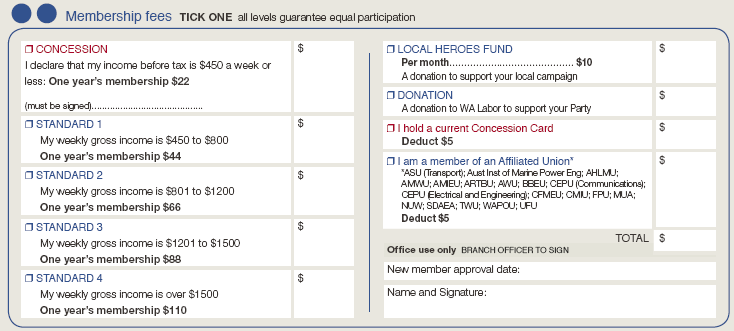
Even though they claim to represent the interests of blue-collar workers, it costs more to join the ALP than the Liberal Party unless you are earning $450 a week or less, in which case the fee is $22 for one year. Membership with the Liberal Party for a year is $25 regardless of income, while joining the ALP will set you back $44 to $110 per year depending on how much you earn.

ALP membership fees

The reason membership is higher than expected is because branch stacking is rampant within the ALP. Democratic processes are no obstacle to winning preselection within the ALP — just sign up members en masse who have only a vague idea, if any, of the candidate they are supporting, paying their membership fees in bulk on their behalf.

Increasing membership fees might discourage branch stacking, but it doesn't stop those who have enough money to buy the stacks needed to win ALP endorsement.

5 August 2009

Conman Kevin

Kevin Rudd is a phoney who has duped voters hook, line and sinker with his mastery of spin that has created an illusion not matched by the outcomes of his policies.

He conned the Right in presenting himself as an economic conservative, but has mismanaged our economy with poorly designed stimulus packages and other policies such as FuelWatch and GroceryWatch where it was clear from the outset that they were not going to deliver. Very little of his stimulus packages went into roads, railways, bridges and other economic infrastructure. Schools are being forced to tear down their assembly halls and build the Julia Gillard Memorial Hall in their place - a poor use of taxpayers' money.

He conned the Left in presenting himself as an environmentalist, yet he is committed to implementing an ETS that far from reducing global emissions, may actually increase them.

People have been so far conned that they immediately dismiss reports about his abusive treatment of staff and vile temper, but they are consistent with what I've learnt via sources close to the PM. His office required some repair work because of his tantrums.

29 July 2009

We've learnt little since the 1930's

The common argument used to reassure us that the current global downturn won't be as severe as the Great Depression is that the actions taken by governments around the world will change the current course of the global economy. The present thinking appears to be that financial systems and our understanding of them have significantly progressed since the 1930's. While they have certainly changed and are more complex than ever before, one can only conclude from a quick look back at recent history that it is wishful thinking to suggest that we're any better equipped to tackle the fundamental problems that financial markets have always faced.

The inescapable reality that lawmakers are less than keen to explain to the general public is that this financial disaster came about because of a debt-fuelled asset bubble in the US housing market and while it was years in the making, they failed to see it coming or take any action to avert the market collapse.

The popular story that this all started with unscrupulous mortgage brokers who preyed on witless borrowers is baloney, just like most of the other rubbish that journalists write in our mainstream newspapers every day. They get rewarded for sales, not truth or accuracy. The cold hard truth is that America's debt binge began with the borrowing of money from China that was raised through its big trade surpluses. The US government, for political reasons, was all too keen for home buyers to live beyond their means with policies that encouraged irresponsible lending.

If our financial systems and management of them were that far superior to the 1930's, then the bubble and mountain of private debt—far greater as a percentage of GDP than it was back then—wouldn't have grown so large and burst. Once a bubble bursts, the damage has been done. It can't be reversed by re-inflating the values of assets that were purchased for more than they were truly worth.

16 May 2009

Brett Mason on the golden rule of Australian politics

Brett Mason has delivered a couple of excellent speeches recounting the Australian Labor Party's history with public finance. The Senator for Queensland is not well known outside politics but he is fairly compelling to listen to with the conviction that he displays in his speeches.

Speech 1

Title:
APPROPRIATION (NATION BUILDING AND JOBS) BILL (NO. 1) 2008-2009
APPROPRIATION (NATION BUILDING AND JOBS) BILL (NO. 2) 2008-2009
HOUSEHOLD STIMULUS PACKAGE BILL 2009
TAX BONUS FOR WORKING AUSTRALIANS BILL 2009
TAX BONUS FOR WORKING AUSTRALIANS (CONSEQUENTIAL AMENDMENTS) BILL 2009
COMMONWEALTH INSCRIBED STOCK AMENDMENT BILL 2009
Second Reading

Date:
Thursday, 5 February 2009


Senator MASON (Queensland) (5:37 PM) —I rise to speak on the Appropriation (Nation Building and Jobs) Bill (No. 1) 2008-2009 and cognate bills. The blinding obscenity about this package is not that it will not actually work. That is obscene but that is not the blinding obscenity. It is not even the fact that future generations will be placed in debt for who knows how long. That is obscene but that is not the blinding obscenity. Even Labor’s financial incompetence is no longer obscene because that is part of Australia’s political folklore—we know the history of Labor governments, particularly federal Labor governments, and we are used to it. The blinding obscenity is that this government and Mr Rudd propose to push through the largest expenditure package, outside of budgets, in Australia’s history without parliamentary oversight. That is what he proposes to do and that is the blinding obscenity of this government.

If you want to know how significant that is—I am not very good with numbers but I did a quick calculation upstairs—we are talking about 42 thousand million dollars. There are, I think, 21 million Australians, so for every man, woman and child in this nation the debt immediately will be $2,000. And for every taxpayer—there are around 9,200,000 taxpayers—the contribution will be $4,565.22. The obscenity is that that debt was going to be placed on every man, woman and child and every taxpayer without proper parliamentary oversight. That is the blinding obscenity of this government. They have been in power for 15 months and already they are pushing through $42 billion without proper parliamentary oversight. That is a disgrace.

But politics is funny—it is an interesting profession. There are those who know the Labor Party well and know how they operate. Mr Latham, a former Labor leader, wrote today in the Australian Financial Review that Mr Rudd and Mr Swan:

… have jumped all over the financial crisis, not with a clear economic strategy in mind but with an urgent sense of the political opportunity it presents.

The stimulus package is about politics, much more than being about economics. Mr Latham knows that, the opposition knows that and Mr Rudd knows that, and that is a disgrace.

The problem—and my colleagues have touched on this eloquently throughout the day—is this: we now have a government that does not believe in anything. One of my favourite topics—and I will get onto this later—is this embarrassing essay from Mr Rudd. The problem is this: the Labor Party now no longer has any coherent ideology or framework.


Senator Boyce —They have Ruddbank.


Senator MASON —Yes, they have Ruddbank. They used to believe in socialism. That failed universally—it has been dropped. Then they developed the Third Way. Remember the Third Way? Mr Blair developed it—and Mr Hawke and Mr Keating. Mr Rudd has just dumped it. And what does he propose to replace it with? Nothing at all. I have read the essay twice. It is pathetic in its sparseness. It is funny when I think of it; in my lifetime the Labor Party used to be a grand party of ideas. I always opposed them. When the Maoists used to run around at university I opposed them. Now of course all they believe in is opportunism and ‘me-too-ism’. So in my lifetime they have gone from Maoism to ‘me-too-ism’. And what a pathetic downhill ride it has been.

I think it was Dostoyevsky who said that the problem is that someone who believes in nothing in the end will do anything. That is the problem with the stimulus package. It is all about politics and very little to do with economics.

My colleagues have all said eloquently that the cardinal rule of stimulus packages is this: make sure they are properly targeted and that you get bang for your buck. It is all about bang for your buck with stimulus packages. Unfortunately, this $42 billion extravaganza fails that test.

One of the centrepieces of the package is the handouts to many Australians. Sure, it is attractive superficially—we all accept that. Many people will think it is terrific. But will it actually make a difference on the ground? Every poll I have seen published says this: most of that money will be used to pay off mortgages and credit cards—to retire debt—and the other part of it will be used for savings and will not be used to spend and to stimulate. That is the problem. Again, there is no bang for your buck. In short, this is a package directed towards social infrastructure rather than economic infrastructure, and that at the nub is the failing of this package.

I accept that building libraries and sports halls might be laudable. Even if you put aside the fact, as my friend Senator Nash said, that that is of course a state responsibility—but I am a generous man so let’s put that aside—what sort of bang do you get for your buck and what return do you get from the stimulus package? The same could be asked of community housing, ceiling insulation or indeed all of the financial handouts to taxpayers: what sort of bang do you get for your buck? What return do you get on the money you spend?

It is estimated that parts of President Obama’s proposed stimulus package in the United States will generate a multiplier as high as about 1.7 to one—that is, every dollar that the US congress votes to spend will generate about $1.70 in the next 12 months. As my colleagues have said, eloquently, that is because the money is being spent on physical infrastructure projects like highways, railways and bridges, which generate jobs during construction and then produce benefits to the economy through reduced transportation costs. In other words, when the orgy is over something still remains. When the orgy is over, there is something for the morning after.

There were a couple of good articles today in the Australian Financial Review. Michael Knox, an analyst from ABN AMRO Morgans, analysed Kevin Rudd’s package. ‘What sort of return,’ he asked, ‘will this country get?’ What return will Australia get from Mr Rudd’s stimulus package? Michael Knox said:

The economic impact of the plan is that GDP growth is expected to be around half a per cent higher than in 2008-09 and about 0.75 to 1 per cent higher in 2009-10.

In 2008-09 we are spending 1.7 per cent of GDP in stimulus to get an increase in GDP of 0.5 per cent. This means we are spending $1 in stimulus to get only 30c in GDP. This is a multiplier of just 0.3—very low by international comparison.

He concluded by saying:

By emphasising social over economic infrastructure, the bang for the buck is so soft it might better be described as a dull thud.

So even within the terms of the government’s own reference this is a very poor package—no bang for the buck.

What about the other objectives? My friend Senator Boyce has raised the issue of jobs. Clearly, the opposition is all about jobs, jobs, jobs. Mr Turnbull has spoken about it relentlessly over the last few days.


Senator Boyce —And eloquently.


Senator MASON —And eloquently! After the debacle of last year’s $10 billion package, where it would seem very few of the promised 75,000 jobs have materialised, the government is now rather more modestly promising that the $42 billion will ‘support’ up to 90,000 jobs. We do not know what ‘support’ means. I am like Senator Boyce; I do not know what ‘support’ means, but presumably it does not mean to create or to maintain.

I go to a quick bit of arithmetic, Mr Acting Deputy President Hutchins, and I am not good at this so you may have to help me. That is 90,000 jobs at the cost of $42 billion, which comes out at $400,000 per job. And those are not new jobs, those are the supported jobs. At $400,000 a job, what a wonderful package! As Mr Costello said in the House yesterday about the government’s new policy to borrow and to splurge, we are reversing 10 years of hard work and we are doing it to support 90,000 jobs at more than $400,000 per job. What a fiasco! That is the Labor arithmetic, and it is not very pretty.

Rather than trying to remake capitalism, which Mr Rudd has tried to do with his sad little essay, he should perhaps do something to ameliorate the pain that ordinary Australians are feeling. I thought it was the job of governments in recessions to help those in pain, rather than to try to remake the economic system, which is Mr Rudd’s preoccupation.

Who are the principal people who should be benefiting from Mr Rudd’s concerns? The unemployed. They are the people at the bottom of the social heap. And what is Mr Rudd doing for the unemployed in this package? This is from a party that supposedly believes in social justice! The government is doing absolutely nothing for the unemployed. Do you know what? Within the next year there are going to be a lot more people who are unemployed. So perhaps the new social democracy that Mr Rudd talks about in this frightful little essay has nothing to do with social justice. The new social democracy is not about social justice at all. There is no concern for the unemployed at all. It is increasingly obscene.

Tim Colebatch wrote in today’s Age:

Those who need it are the poor people who bear the cost of the recession on behalf of the rest of us: workers who lose their jobs, apprentices laid off, youngsters who can’t even get into the labour market, and businesses and self-employed people who go broke. There is nothing in this package for them.

So much for new Labor! So much for a party trying to rediscover a new direction! So much for a sad, new social democrat who does not believe in social justice!

The worst thing, however—and my colleagues have spoken about this forcefully and with passion—is the tremendous cost to the economy for future generations. It is about sizing up debt for years and years to come, for our children and potentially our grandchildren. Others have spoken at length today about the government’s reckless policies that in just over a year have managed to turn a $22 billion surplus into a $20 billion budget deficit and have sent Australia back on the road to government debt. That is the problem. What is worse, judging by the legislation introduced by the government, is that we can expect it to get even worse.

What has the government done? It has given itself plenty of wriggle room. It is going to allow itself to borrow up to—


Senator Fierravanti-Wells —$200 billion.


Senator Fisher —$200 billion.


Senator MASON —‘$200 billion,’ is the chorus from the opposition. What worries me—what worries the opposition—is this: when we came into government in 1996 the budget deficit was about half that; it was about $96 billion. It took us about a decade to pay that off. I hate to think how long it will take to pay off if it is $200 billion. It could take an entire generation to pay off a debt like that. It would become in a sense systemic—as it has become in the United States and in western Europe. In fact, 10 per cent of the budget could be paying for budget deficits of previous years. Government debt can so overburden budgets that governments are crippled. And who pays the debt? Taxpayers in future generations. The worst thing that could happen to this country, sir, is this: like the United States and like western Europe we get used to living with—


Senator Brandis —Structural.


Senator MASON —structural debt that gets written into the budget each year and cripples us. That is the long-term problem.

You will recall that Mr Costello years ago commissioned the Intergenerational Report. You will recall his concern about intergenerational equity. This is another matter of social justice, I might add. The opposition is raising another matter of social justice. Who will bear the burden of today’s splurge? The point of intergenerational equity is, as Mr Costello pointed out, this: the changing demography of Australia means that with an ageing population there will be fewer taxpayers over the next generation to foot the bill. That is the problem. So the systemic, structural debt that Senator Brandis mentioned in his excellent address today is not just some sort of myth; it is highly likely. That is what petrifies the opposition.


Senator Brandis —And no Labor government will even start paying off.


Senator MASON —That is right. In the end, as always, it will be the coalition that has to pay the debt off. Some might think that I have a boring life. Perhaps I do. But I read with morbid curiosity Mr Rudd’s essay, ‘The global financial crisis’. To those people in the gallery: I suggest that you do not bother.


The ACTING DEPUTY PRESIDENT (Senator Forshaw)—Senator Mason, I suggest that you direct your remarks through the chair.


Senator MASON —Thank you. I suggest to you, Mr Acting Deputy President Forshaw, that you do not read it either. Let me point out the salient parts. Right towards the end of this embarrassing essay, Mr Rudd quotes President Sarkozy of France saying ‘laissez faire, c’est finis’; it is the end of laissez faire and the end of liberalism. For a start, as my colleagues know, France never adopted free market economics. That is why they have had 10 per cent unemployment for the last 20 years. Even worse, the irony is perhaps lost on Mr Rudd of something that I read in Monday’s edition of the International Herald Tribune. It was:

Prime Minister François Fillon on Monday rejected demands that the French government seek to stimulate consumer spending, rather than follow his plan to stimulate corporate and infrastructure investment, to lift France out of its economic slump.

He rejected demands; France rejected it. The article went on:

‘It would be irresponsible to chose another policy, which would increase our country’s indebtedness without having more infrastructure and increased competitiveness in the end,’ Fillon said in a speech in Lyon.

If the French can get it right, why can’t this government? Even Mr Rudd’s continental idols do not agree with him. Even the French are spending their money on roads, buildings, ports and railways and renovating infrastructure.

I suppose it comes down to this in the end with this embarrassing little essay: there are three policy prescriptions in this essay. They are: spend, spend and spend. There are no other ideas in it at all. And that is the problem with the Labor Party today, you see: they actually do not believe in anything except opportunism. That is at the heart of the problem in the debate in this parliament and the problem with Mr Rudd. Dostoyevsky was right: if you believe in nothing, you will do anything to survive politically, even if you have to mortgage the country in so doing and even if you have to mortgage future generations. That will be on Mr Rudd’s head and on the head of this government. (Time expired)


Speech 2


Title:
ADJOURNMENT
Australian Labor Party

Date:
Thursday, 19 March 2009


Senator MASON (Queensland) (5:52 PM) —Mr President, I seek leave to speak for up to 20 minutes on the adjournment.

Leave granted.


Senator MASON —I thank the Senate for its indulgence. There is a new dichotomy in Australian politics. We have today in the opposition economic conservatives. We have in the government former economic conservatives. But they are much happier today because no longer do people in the government have to live a lie. Friends like Senator Carr can tax, they can spend and they can send the nation into debt as much as they like, and they are much happier about that. Senator Carr’s old boss, former Premier Joan Kirner, said the other day that she was so happy that debt was no longer out of fashion. Debt in effect for Ms Kirner is the new black; debt is again fashionable.

The former economic conservatives, the government, have a very interesting solution to the current economic crisis. All of us in this chamber know this: the current economic crisis was caused by individuals and indeed by companies borrowing and spending far too much. In the United States, and indeed elsewhere, far too much money was borrowed and far too much money was spent by individuals and companies. What is the solution offered by the government? It is for governments to borrow and spend even more. That is the solution of the government. After companies and individuals have spent too much and borrowed too much, the nation, the government, should borrow and spend even more. That is the solution. It is a bit like drinking to cure a hangover. That is the analogy. That is the idea the government has: to keep on spending and borrowing even more and more and more.

There has been a lot of talk over the last two weeks about political DNA, about what makes political parties and political leaders tick. A quick look at history will tell us about every single Labor government since Federation. What does it tell us? It tells us this: every single federal Labor government puts our nation further into debt—every time. There have been 10 Labor prime ministers and they have put this nation into further debt every time. There is not one exception. Every time you have a Labor government they put the country further into debt. Debt is always higher when Labor governments leave than when they arrive—every single time. The farewell gift of Australia’s previous nine Labor prime ministers is more debt. That is the iron rule of Australian federal politics: every Labor government, more debt.

Go right back to the first one: Chris Watson. He was only there for a short time, but there was more debt. Andrew Fisher—he spent a lot; he created a lot more debt. Billy Hughes—again, he created a lot more debt. James Scullin—there was much, much more debt. John Curtin and Ben Chifley—again, they left far, far more debt than there was when they turned up as prime ministers. Then, of course, there was Mr Whitlam. We know what he did. What did he do? He borrowed and borrowed, and there was more debt. At least it is consistent. There is always more debt.

The one thing that is in Labor DNA is debt—every single time. Then, of course, there were Mr Hawke and Mr Keating. It is funny, you know. They did not start off so badly, but in the end the DNA came out. Mr Hawke and Mr Keating left this country in debt—$96 billion. Then, finally, there was Mr Rudd. Mr Rudd also, after six months, spent $50 billion and put the country into debt again. That is 10 Labor prime ministers: Watson, Fisher, Hughes, Scullin, Curtin, Chifley, Whitlam, Hawke, Keating and Rudd—10 out of 10, more debt. There is not one exception. Every Labor Prime Minister creates further debt for this country. It is a disgraceful record. In war and peace, in good times and bad, there is always debt. Debt is in the Labor Party’s DNA—not jobs; but debt. The excuses change, but it is always the same rationale—debt, debt, debt and debt, from every one of the last 10 Labor prime ministers.

There are some who doubted Mr Rudd’s commitment when he first came into parliament. They doubted whether he would be a good Labor prime minister, because he did not come from a union background—he was a former diplomat. They were concerned that he might not know the Labor Party’s ways. But the Labor Party need not have worried, because he has the DNA. He has the debt gene. He has it; the Australian Labor Party need not have worried. Mr Rudd knows how to spend and he knows how to put the nation into debt. He has never forgotten that. Mr Rudd fits in perfectly with the other nine former Labor prime ministers in creating further and further debt. This country must never forget that when Labor left office they left this country and its people with $96 billion of debt—paying about $8 billion of interest each year to service that debt. That is what Mr Hawke and Mr Keating left this country, just like all the other Labor prime ministers did: debt. And they left it.

It has taken just six months for the Labor Party to spend over $50 billion and, of course, to extend a credit line of $200 billion. If it ever happens—and it will—that Labor spends the $200 billion, we will start to have the problem of structural debt. That is where, every year, the budget gets consumed by interest on debt—just like in western Europe. It becomes part of the political culture, the fabric and the way of life of, let us say, France. And 10 per cent of the budget is taken up on interest payments on debt. That is the problem. This credit line of $200 billion signifies the fact that the Labor Party will do it if they feel it is necessary.


Senator O’Brien interjecting—


Senator MASON —Well, it’s funny. What worries me is that Mr Rudd talks about turbocharging social democracy; what he has done is turbocharge debt. Perhaps that is the same thing. That is the problem. The debt has gone up $50 billion in six months. Only twice in this nation’s history—during the McMahon government and under the Howard-Costello government—has there been no net government debt. What did Mr Whitlam do as soon as he got in? He fixed that problem. He put the country back into debt. What happened when Mr Rudd got in? He put us back into debt, just like the other nine Labor prime ministers did. The one consistent fact of Australian political history, the one consistent political fact about Australian Labor governments, is debt—and there are no exceptions. What a coincidence! We know what is in Labor DNA. It is debt. There have been no exceptions. It is always the same. The Labor Party will bugger up the economy and they will expect the coalition to fix it up. It happens every time. With 10 Labor prime ministers, the coalition government to take over has been expected to fix and pay off the debt.

This is a moral question. What about the intergenerational equity? Mr Costello has spoken often about this. This is a moral issue. The Labor Party love to talk about equity, but they do not mind bankrupting our children or grandchildren to pay off the debt. It is all very well to spend on behalf of today’s voters, but who is going to pay off the debt? Our children and our grandchildren will be saddled with the debt that these people create, just like all the other Labor governments do. There are no exceptions. It is the one ironclad rule of Australian politics. They always say that the great dictators love children and hate their parents. You could never accuse Mr Rudd of that. He loves the parents; we are just not too sure if he loves the children who will be saddled with the debt that he is creating today, just as the other nine Labor prime ministers have created debt in the past. Every Labor Prime Minister puts this nation further into debt. It is the ironclad rule of Australian politics. It is absolutely disgraceful, if not scary.

Let us not forget how Labor spent their first year in office. How I remember Mr Swan, Mr Rudd and even Senator Conroy saying: ‘The economy’s overheated. The inflation genie is out of the bottle.’ They talked it down: the economy was overheated, interest rates were going up and the economy was out of control. We said, ‘Go for growth.’ They talked the economy down just at the time when it needed to be talked up, making the recession even worse. I will never forget how ‘the inflation genie was out of the bottle’—at four per cent—and things were so terrible, weren’t they! Now, a few months later, we know what economic terror is, their having talked down the economy. If they had gone for growth, they would not have had the problem. Instead, they kept talking down the economy and they failed to build up business and consumer confidence. So well done! Mr Rudd even got that wrong—first year in office: wrong.

What is the intellectual edifice behind this change from being an economic conservative? What is it based on? It is political opportunism, but this voodoo economics is based on the famous essay of Mr Rudd’s in the Monthly, which of course I have read. The philosophy, if you call it that, is unusual because it reflects an unusual state of mind. Mr Rudd’s political and economic philosophy changes at every opportunity. He was a Christian socialist. Dietrich Bonhoeffer, the great German pastor, was his spiritual, economic and social mentor, but he abandoned that and decided he was a neoliberal when he was after the shadow Treasurership before the 2004 election, under Mr Latham. He was trailing Mr Latham’s coat-tails through Labor caucus, saying he was a neoliberal. So he went from the German Dietrich Bonhoeffer to the Austrian Friedrich Hayek in a very short amount of time.

Then, upon becoming opposition leader, Mr Rudd called himself a self-styled economic conservative, and he was proud of it—very, very proud of it. Mr Rudd was so proud of styling himself as an economic conservative. He was out and proud about being an economic conservative. There was no difference between him and Mr Howard at all, really; he was ‘Howard lite’. He was an economic conservative and he loved every minute of it.

The first whiff of economic grapeshot, the first bit of real tension, the first downturn, and what happens? He drops all that. He drops Bonhoeffer, drops Hayek, drops economic conservatism and becomes a reborn social democrat all of a sudden. So he has changed four times in just a couple of years. Mr Rudd is, in a sense, Australia’s first post-modern Prime Minister, because he does not actually believe in anything. No-one I know has changes of hearts like that, except Mr Rudd—no-one at all. My old friend Senator Carr—I always have a go at him, I know—is wrong about everything, but at least he believes in something. Mr Rudd does not believe in anything. He changes his mind every second week. He is like a schizophrenic Harry Potter figure, baring his latest philosophy to some sort of focus group in Labor headquarters in Sussex Street over a Chinese meal, with dim sims. That is where he has got this philosophy from; it is pathetic. It is this sort of groupthink.

The essay in the Monthly is wrong. Not only is it based on hypocrisy; it is intellectually lazy, ignorant and wrong. Mr Rudd of course does not like talking about the fact that Mr Blair was one of the great neoliberals of the latter half of the 20th century; a Labour Prime Minister was one of the most significant neoliberals of the 20th century—as well as Mr Hawke and Mr Keating, of course, to their partial credit; I will give them that.

But perhaps even more disturbing than the shocking hypocrisy of the Labor Party adopting neoliberalism as well—even forgetting the hypocrisy—is the moral argument here. More people have been moved out of poverty in the last 20 years than were moved out of poverty in previous recorded history. More people have moved out of poverty in the last 20 years than ever before in human history. It is not because of communism or socialism or social democracy but because of free trade—yes, free trade. Free trade and neoliberalism created more wealth for the Chinese than for anyone else. The Chinese do not go on like Mr Rudd does. Mr Rudd takes advantage not only of the hypocrisy but of ignoring great moral arguments.

What the Labor Party does not seem to understand is that this is about good regulation. The fact is that the reason why Australian banks are among the best in the world is that the regulation is very good. This same system that Mr Rudd decries in Australia—the neoliberalism he criticises—is the same system that gave us the best banks in the world. So not only is this article in the Monthly pathetic, lazy and ignorant; it is just plain wrong.

And now it is worse. I understand that our high commissioners and our ambassadors are having to run around and hawk this line to world leaders. When Australia’s High Commissioner to the United Kingdom meets Her Majesty the Queen, I suppose he says, ‘Here, have a look at this article from the Australian Prime Minister.’ In Ulan Bator they probably take a translation of this article and give it to the local president, prime minister, doge or whoever it happens to be.

Our diplomats are expected to run around the world with this embarrassing little essay, which is ignorant and hypocritical. Our embassies have been changed into publishing houses these days. It is a pathetic, intellectually lazy and ignorant piece of work. To have the hide to have our diplomats running around with this! I wish they would peddle something I wrote, rather than this rubbish. Can you imagine asking our diplomats—our high commissioners and our ambassadors—to run around with this stuff? It is absolutely embarrassing. I feel sorry for them.

Who are the political legatees of this appalling ideology? Who are the people who love debt—debt being the new black to the Labor Party? Of course, in Queensland it is Ms Bligh, with $74 billion in debt. And she racked up that $74 billion of debt—guess what—in boom times. She has just had record mining receipts of billions of dollars. She has received billions of dollars in property taxes and hundreds of millions in GST. And do you know what she has done, Mr President? She has still racked up $74 billion of debt. I thought the $96 billion of debt federally in 1996 was bad. That was spread among about 20 million people. This is $74 billion spread among 4½ million people. Talk about structural debt. When will this debt ever be paid off, Mr President?

Of course, the Labor Party do not worry about that. They are not concerned about paying off the debt at all, because there is one golden rule of Australian politics: every Labor Prime Minister—from Chris Watson through to Kevin Rudd—spends more money than they raise. They leave this country with more debt. That is an iron rule of Australian politics. And this diseased DNA is now spreading to the Labor states. We have got Ms Bligh with $74 billion in debt and she does not seem to give a damn. It costs $10 million a day in interest alone to service that debt, and Ms Bligh does not care at all. (Time expired)

10 May 2009

What should be done about the violence in Northbridge?

The regular violence that we see in Perth's main entertainment precinct every weekend is clearly unacceptable to the community standards of most Western Australians.

After 3 or 4am on Sunday morning, the fights on the streets—in particular James St—follow one after another non-stop. Last night the police were attending to one fight while another man who was only metres down the road was out of his mind on some stimulant (and probably alcohol as well) and screaming at the bouncers threatening retribution by killing them and destroying the club. After a while the police did eventually casually walk over and intervene, but it should have been handled well before then. They were overstretched and you got the impression that the chaos was all rather normal to them.

The prime factor in all the violence is alcohol, but it is such a big part of our culture and lifestyle and consequently completely banning it is not a realistic option.

The only solution that I am reasonably confident will effectively address this problem is to close down all the licenced premises and clear the streets of all loiterers at some time between 3 and 4am. I am a regular patron of Northbridge's nightclubs and am reluctant to see this happen, but the physical safety of people in the area comes first.

I spoke to some nightclub security staff who offered their thoughts on curbing violence. The general message I received was that the people on the streets need to be dispersed, especially at the front of venues where people congregate. Closing off some roads such as James St would open up the area and reduce the opportunities for altercations between people who are intoxicated and just passing by each other.

6 May 2009

Letter to the Liberal Party regarding the proposed Rio Tinto-Chinalco deal

I recently wrote to senior members of the Liberal Party expressing my misgivings about the federal government approving the purchase of a $US19.5 billion stake in Rio Tinto by Chinalco, which is wholly owned by the Chinese government:

From: Justin Lee
To: Joe Hockey, Julie Bishop, Malcolm Turnbull, Mathias Cormann
Date: 1 May 2009 13:31
Subject: Disapprove of Chinalco-Rio deal

Libs,

I just want to let you know that I am a Rio share holder, and while the value of my shares have plummeted with the downturn (they've lost over 50% of their value), I disapprove of Chinalco owning such a substantial stake in the company. Chinalco is owned by a totalitarian state and the deal is not in the national interest.

Cheers,
Justin.

I received this reply from Julie Bishop:

From: Bishop, Julie (MP)
To: Justin Lee
Date: 6 May 2009 17:03
Subject: Chinalco-Rio deal

Dear Justin

Thank you for your recent email, receipt of which was acknowledged by my adviser Sue.

I have read the response from Malcolm Turnbull and as he pointed out, the decision of the Board of Rio Tinto in relation to Chinalco raises a number of significant issues of national interest.

The Coalition welcomes foreign investment in Australia and recognises the important role it plays in our economy. However large Chinese companies, unlike other sources of foreign investment are owned, either in part or full by the Chinese Government.

The Coalition does not believe it is in our national interest for the Chinese Government to be purchasing controlling stakes in Australian strategic assets and resources.

The final decision to approve the purchase of Australian companies, land and mineral rights rests with the Treasurer, however the Foreign Takeovers and Acquisitions Act 1975 and the Foreign Investment Review Board regulate, review and report on this process.

The Coalition is committed to ensuring the sale of any our strategic assets and resources is in the national interest.

Best wishes

Julie